
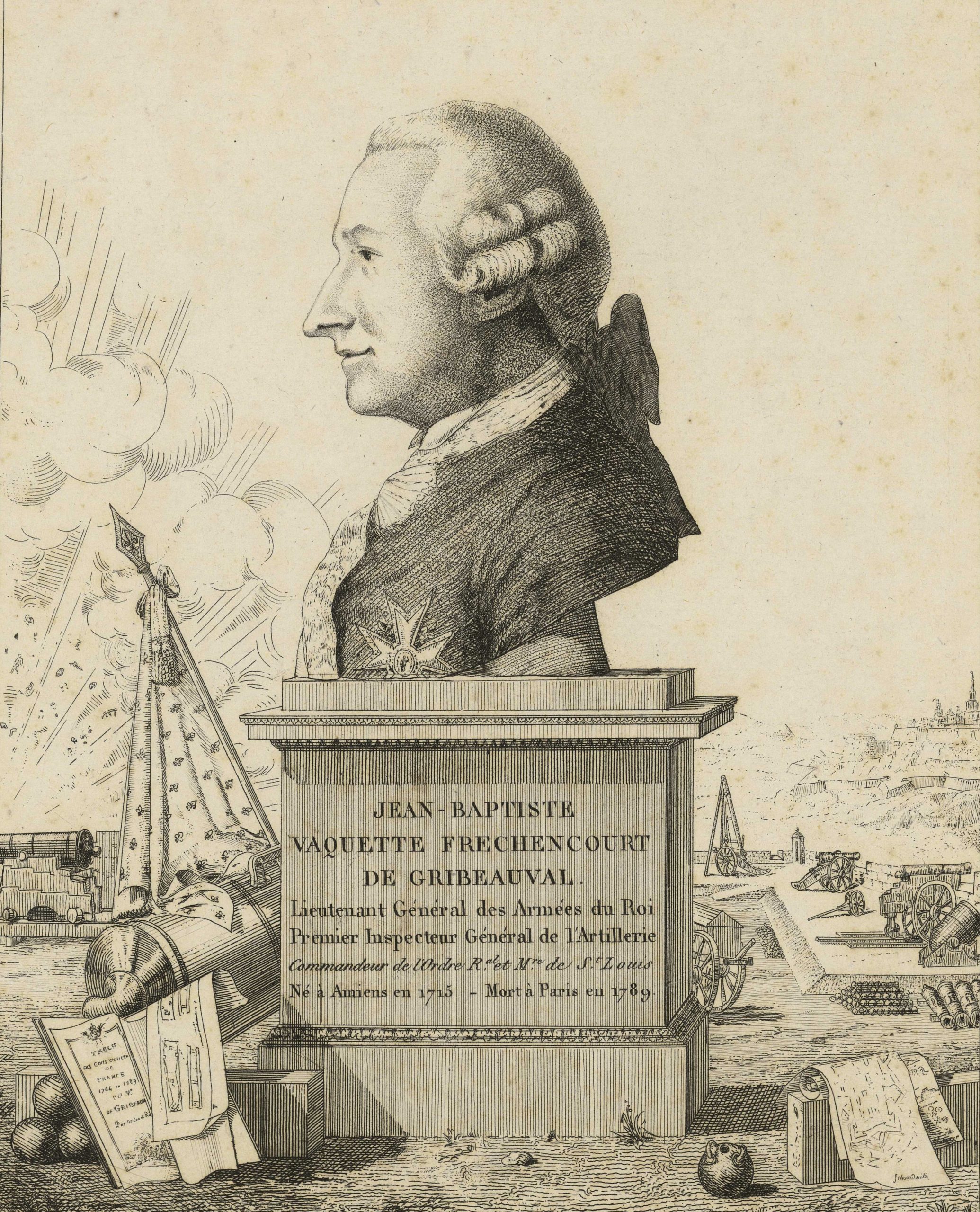
Lieutenant General Jean-Baptiste Vaquette de Gribeauval (1715 – 1789) was a French artillery officer and engineer who revolutionised the French artillery. These guns proved essential to French military victories during the Napoleonic Wars. Gribeauval is credited as the earliest known advocate for the interchangeability of gun parts. He is thus one of the principal influences on the later development of interchangeable manufacture.
The Gribeauval system (French: système Gribeauval) was an artillery system introduced by Lieutenant General Gribeauval during the 18th century. This system revolutionized French cannons, with a new production system that allowed lighter, more uniform guns without sacrificing range. The Gribeauval system superseded the Vallière system beginning in 1765. The new guns contributed to French military victories during the French Revolutionary Wars and Napoleonic Wars. The system included improvements to cannons, howitzers, and mortars. The Year XI system partly replaced the field guns in 1803 and the Valée system completely superseded the Gribeauval system in 1829.

Gribeauval’s reforms encompassed not only the cannons but also the gun carriages, limbers, ammunition chests, and the accompanying tools. The system’s field guns included 4, 8, and 12 pounder cannons and 6 and 8 inch howitzers. The gun barrels were cast shorter and thinner, while gun carriages were built lighter and narrower. These improvements dramatically reduced the weight of an artillery piece. The carriages were standardized and built with interchangeable parts. The carriages had two positions for the trunnions, a forward position for firing and a rear position for traveling. The draft horses were harnessed in pairs, rather than single file. The guns were fitted with a rear calibrated gunsight and an elevating screw. The last two improvements allowed gunners to more easily aim the cannons. With these improvements better gunners were needed to operate the new field pieces, France set up artillery schools to train its soldiers.